
Moving Palliative Care from the Hospital to Home
Moving Palliative Care from the Hospital to Home

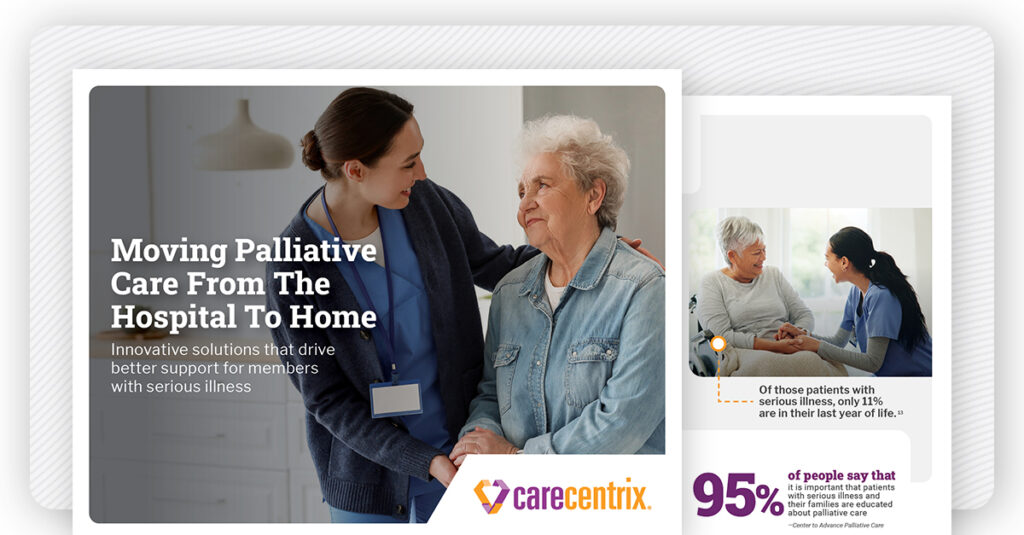
Payors are constantly looking for ways to enhance the member experience, improve care quality, and reduce costs. One pressing challenge you may be facing is how to provide the right support for members with serious illness. With baby boomers reaching age 65 or older by 2030¹, paired with longer life expectancies and a rise in chronic diseases, the number of people living with serious illnesses—and the associated care costs—is expected to increase significantly.
In this eBook, we help payors prepare for these challenges by exploring a transformative approach to palliative care that shifts from hospital-based care to proactive, home-based models. This shift not only enhances access and quality of care but also addresses critical gaps in the member journey that often go unnoticed and can lead to unnecessary readmissions and increased costs.
Why Download this eBook?
-
- Discover the Impact of Serious Illness on Health Plans
Did you know that just 5% of patients with serious illness account for nearly 50% of healthcare spending? 2 - Address Barriers to Awareness and Access
Unfortunately, 60% of patients who would benefit from palliative care never receive it due to lack of awareness and understanding.3 Access is also a barrier particularly for those living in rural communities.4 - Learn How New Palliative Models Can Lead to Lower Costs
Hint: It can lower costs by as much as $7,254 in savings per patient!5 - Uncover the Many Benefits of Palliative Care for Your Members:
- Improved access to care
- Monitoring to proactively identify gaps in care
- Management of symptoms to improve quality of life
- Proactive care that helps to manage costs
- Trusted relationships that allow for holistic support
- Discover the Impact of Serious Illness on Health Plans
Sources:
- United States Census Bureau. (2019, December 10). By 2030, All Baby Boomers Will Be Age 65 or Older.
- McGough, M., Claxton, G., Amin, K., Cox, C. (2024, January 4). How do health expenditures vary across the population? Peterson-KFF Health System Tracker.
- Parker, J. (2019, July 3). Report: 60% of Patients Needing Palliative Care Do Not Receive It. Hospice News.
- Cai Y, Lalani N. (2022 January) Examining Barriers and Facilitators to Palliative Care Access in Rural Areas: A Scoping Review. Am J Hosp Palliat Care. 39(1):123-130. doi: 10.1177/10499091211011145.
- Palliative Care Projects. Synthesis of Evaluation Results 2012-2021.
Related Blog Posts

The New Era of DME: Smarter, Faster, and Built for Better Outcomes
With its reliance on manual, paper-based processes, outdated communication channels,…
Closing the Gap: How Timely Delivery of Home Health Care Drives Better Outcomes
The High Stakes of Post-Hospital Care The transition from hospital…

CareCentrix: Empowering Health at Home
Empowering Health at Home through effective care coordination and benefit…